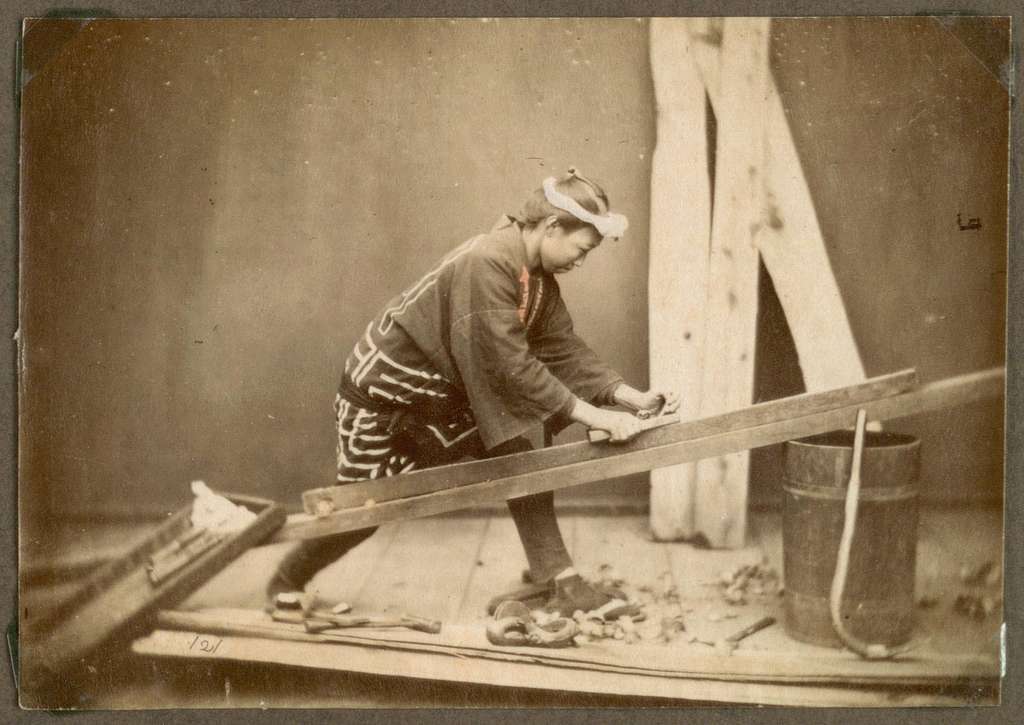
The skills required for traditional Japanese carpentry were acquired by an exacting apprenticeship under a master craftsman. Training usually began at the age of eight and would initially involve time spent partly at a temple school, where the novice would learn to read, write, and calculate numbers. For the first two or three years under the master, the apprentice would only perform menial tasks and be introduced to the tools of the trade.
The most important tool was the whetstone. A proper Japanese carpenter will spend half his time sharpening chisels and planes. The preparation of timbers and the creation of joinery requires tools that are razor-sharp. Pieces are sized and squared by shaving off layers of wood. Using a dull tool tends to leave the surface ‘fluffy’, inviting moisture, decay, and insects. The clean cuts made by very sharp knifes, chisels, and planes keep more of the cells of the wood intact. Until the Miromachi period (1326-1573), timbers were prepared by splitting with axes and wedges, then finished with adzes and long-handled planes known as Yariganna. The use of saws was rare.
Japanese chisels, Nomi, have long handles and short blades. This may be a result of the scarcity of steel in Japan combined with the notoriously high standards of quality demanded by Japanese blacksmiths. There are bench chisels, paring chisels, mortising chisels, as well as long-handled Yariganna. Like the famous Japanese samurai sword, the Japanese chisel is formed by folding and welding together hard and soft metals to produce a blade of the finest quality. The softer metal absorbs shock while protecting the hard steal cutting edge that is sharp yet brittle. The bevel of the Japanese chisel is between 20 and 30 degrees, with those required for paring and planing being shallower.
 Mysteries of the Carpenter