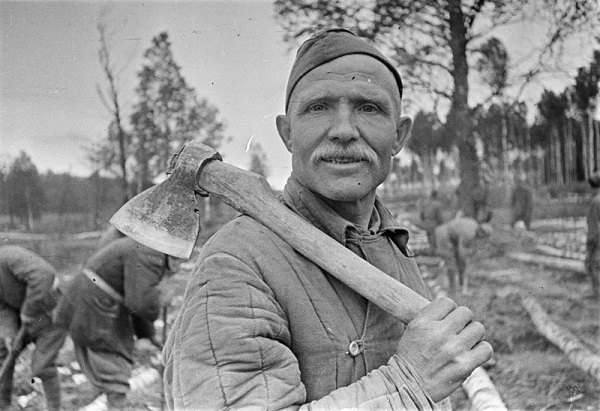
The history of carpentry in the north and east of Europe is characterized by the use of the axe, adze, and knife, as opposed to that of the west and south, that inherited the Mediterranean traditions of the saw, chisel, and plane. This difference is related to the techniques of horizontal log construction, or ‘blockwork’, in the former, and timber-framing in the latter. Blockwork, or blockbau in German, is more suitable to the ample softwood of the north-east versus the oak supply west of the Rhine. While western Scandinavians did employ vertical framing early on, as one moves east towards Finland and Russia, horizontal log building is more prevalent and perfected. The key to correct log construction is proper corner joinery, usually a half-round cradle notch that allowed for a suitably tight fit between the horizontal timbers. This joint, however, requires the log ends to protrude. Square-notch and dovetail joints were introduced to alleviate this problem. By the medieval period, many logs were notched or squared lengthwise to avoid horizontal gaps.

In Russia especially, we see the predominance of the axe used for this work. In fact, the saw was not widely used until the time of Peter the Great (1672-1725). The felling axe was used for trimming, splitting, cutting, and carving. In many places in eastern Europe, and in alpine regions, there was a mixture of techniques, using both horizontal logs and vertical posts. From Bavaria to Romania, axe-work remained popular until the 19th century.
 Mysteries of the Carpenter
