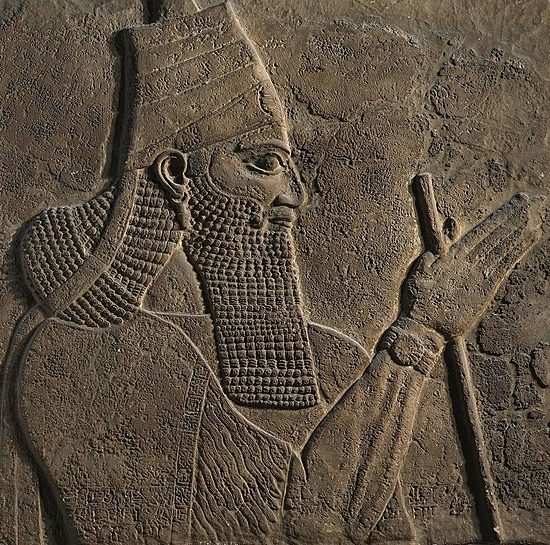
Tiglath-Pileser III, King of Assyria( 745–727 BC), demonstrates a measuring staff. British Museum, Public domain, via Wikimedia Commons
Regardless of family connections, not just any man could aspire to become a master carpenter. Not only would the apprentice woodworker have to be physically able to perform the heavy and mundane tasks required by his master, but he would also be expected to accomplish these things with a certain amount of speed and agility. Aside from these physical aspects, various abstract qualities would need to be learned concerning measurement, proportion, geometry, prices, commerce, and the calculation of material quantities required for the job.
Algebra and geometry were well known to the ancient Mesopotamians, with “Pythagorean Theorem” being employed there at least a thousand years before Pythagoras himself. Standard measurements and spacings were counted in ‘reeds’, ‘cubits’, and ‘fingers’. These human-scale measurements worked for the carpenter of all cultures up to recent times when the unwelcome intrusion of the industrial-based metric scale caused much friction. Knowledge of proper angles was necessary, not only for carpentry, but also for sharpening the desired cutting edge on axes, saws, and chisels. The Mesopotamians derived the sexagesimal (base-60) system from yearly astrological observation, giving us the 360 degree circle.
 Mysteries of the Carpenter