
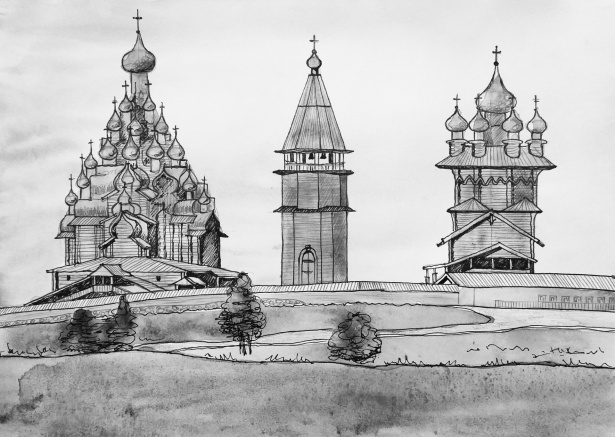
Russian carpenters found rectangular plans restricted by the length of available timbers, and so were able to add interior space by designing octagonal shapes to maximise the interior area and still provide a strong interlocking system. A central octagon built higher than the other parts of the building became common. The multi-domed wooden churches of Russia have a long history, which begins with the great cathedral of St. Sophia at Novgorod, in the 10th century. In the year 1036, the grand Duke Vladimir commissioned expert carpenters from Constantinople to build the grand cathedral at Kiev, then the center of the Russian Kingdom. This church, long since disappeared, was covered by fifteen magnificent guilt domes. While the multi-coloured and domed Church of St Basil at the Kremlin in Moscow is the very symbol of Russia itself, the true aficionado of Russian carpentry will point to the Karelia region, bordering on Finland, and the small island of Kizhi, where, on Lake Onega, lies the epitome of the Russian style. The Cathedral of the Transfiguration has an octahedral central core superimposed on a Greek cross design that is further topped by two more blockwork octahedrons rising to support 22 large onion domes. The gables are ogee-shaped, following a design known as botchka. All is constructed with dark pine logs expertly stacked and joined by axe work. Roofs and domes are covered beautifully by silver aspen shingles. Hans Jurgen Hansen writes that the church at Kizhi is “a masterpiece of Russian folk architecture in conception and execution”. It was built in 1714 during the Great Northern War with Sweden under Peter I, and projects Russian culture upon a disputed borderland. Richard Price relates the legend of Nestor, the master carpenter of the church, who, after completing the cathedral, threw his axe into the lake, exclaiming “the world has never before seen, and never will again, see its like!”
 Mysteries of the Carpenter