
By the time of the early Roman empire, many townhouses had additional storeys and there appeared, for the first time, apartment buildings of six or seven storeys. These were known as insulae or ‘islands’ and were built of brick and timber. Wealthier Romans lived in detached houses known as Domus.

Roman city houses differed from the Greek in that they were built closer together and thus presented problems of drainage and water collection. The courtyard was replaced by an atrium, wherein the inner court was partially covered by a wood-framed funnel, the compluvium, that directed rainwater through a central opening to a basin, or impluvium. The Romans were forced, by crowded circumstances, to develop more sophisticated drainage via sewer systems and water distribution by way of aqueducts, fountains, and atria. Later country villas combined Greek and Roman styles, with multiple atria and courtyards. There were few windows and so the household life was centered around these openings, which provided ventilation and sunlight. In the houses of the elite, wooden posts were replaced by marble columns, but the roofs, and much else, were still made of wood.
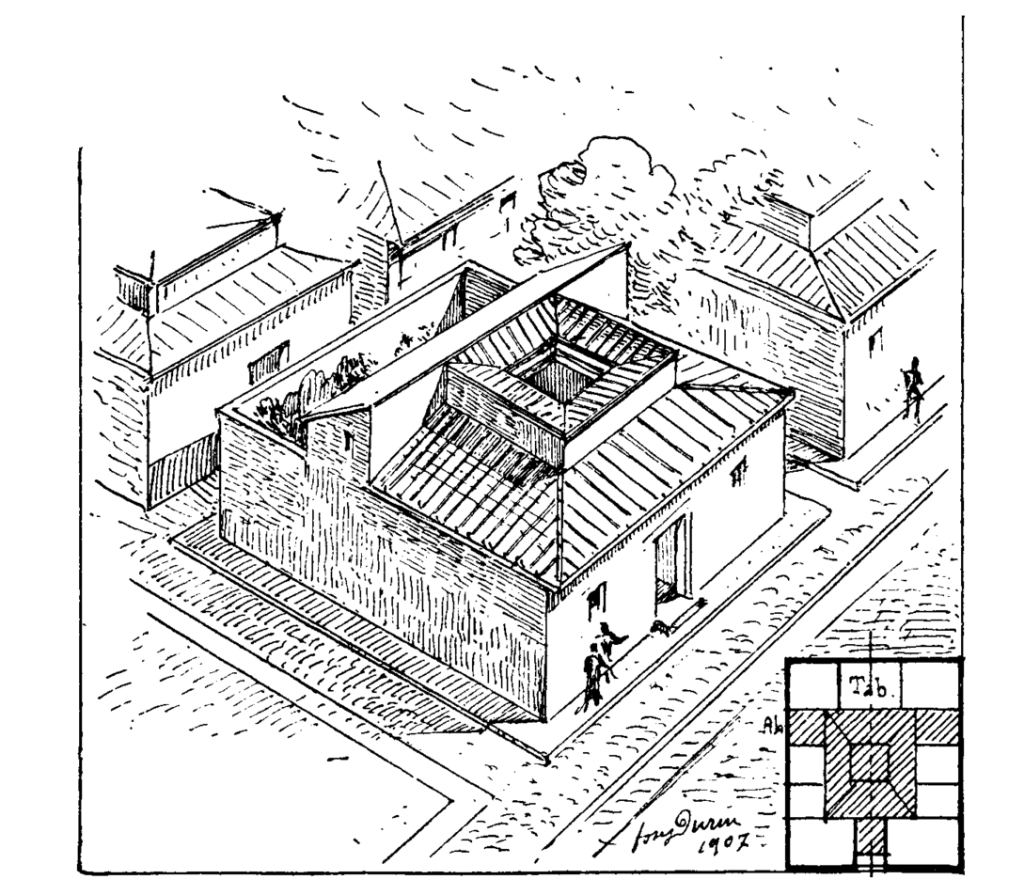
In the Roman house, beams and joists were socketed into the brick and stone walls or rested on stone corbels. Sizes depended on the span and on the quality of lumber used. Staircases usually rested on initial stone steps and were either closed with risers or left as open treads, allowing for a steeper stair or even a ladder. Good doors were a precious commodity as they required well-joined rails and panels to prevent warping. Doors had no hinges, but instead rotated on hardwood pivots, sometimes with bronze caps. Bronze, and later iron was used to strengthen the door with nails, bolts, and straps.

 Mysteries of the Carpenter