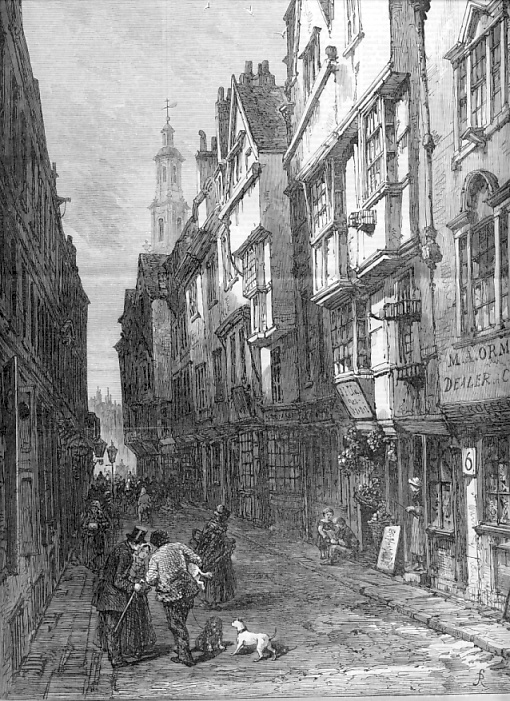
The Illustrated London News http://gerald-massey.org.uk/bezer/b_deprivation.htm
By the 15th century in France and Germany, full grown trees had become so scarce that the use of shorter and shorter pieces became necessary. This meant more careful and complicated joinery. Where half-lapping was once preferred, tenoning became more necessary. The use of diagonal bracing also increased in the form of corner braces, ‘saltire’ cross-bracing, and bracketing to support overhanging stories or ‘jetties’. In many medieval German town houses, the wooden pegs used to secure the joinery were often tapered and left proud, to be driven further in as the timbers dried. The wedge-shaped planks known as scheibling were used to keep floor/ceiling boards set tight.
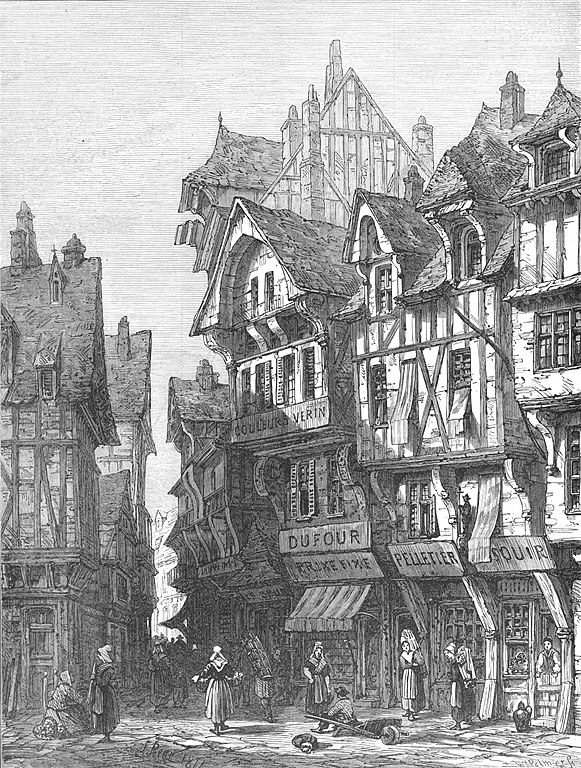
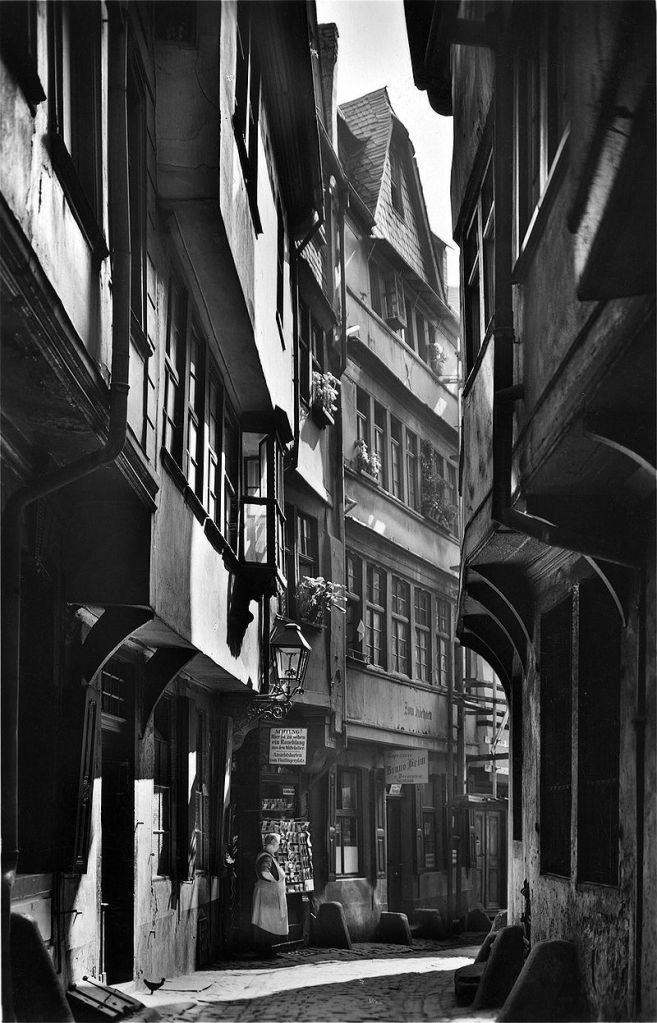
Town houses in medieval Europe were typically designed as having foundations of masonry with two storeys of timber above. The rectangular plan was 16 to 20 feet across the front and 30 to 40 feet on the sides. There are still some examples of this architecture in Paris, Beauvais, Rouen, and other towns. Most towns in the Middle Ages were surrounded by walls that restricted the lateral growth of buildings, and so buildings became taller and often the stories above the street level were projected outwards, which was known as ‘jettying’. Jetties were constructed by cantilevering joists over the top plate of the first storey or by using triangular brackets to support the jetty. Sometimes, such as in Rouen, principal joists were supported by a thickening, or shoulder, at the top of the supporting post underneath. Jetties increased the living space in the town houses and provided protection from the rain at ground level. As time progressed, more jettied stories were added and in some narrow city streets, people could shake hands with their neighbours across the way. In the year 1410 the city of Frankfurt restricted jetties to one yard, and the second jetty to three quarters that. Regulations regarding sanitation and safety saw to the restriction of jetties in most other European towns by the late Middle Ages.
 Mysteries of the Carpenter