Although many items of old time carpentry…have passed over to the machine, the complete craft covers such a wide variety of unusual and unexpected requirements that, in my opinion, there is likely, to be a perennial demand for the skilled workman…The machine has released man from drudgery, the logical consequence being that this displacement of employment should find its remedy in craftwork of far higher orders than hitherto has been possible. – Walter Rose, The Village Carpenter, 1938.

One can argue that machinery brought extra scope and fostered higher levels of skill. Hentie Louw states convincingly that “mechanisation brought significant material benefits to the trade, not the least of that was that it made the joiners’ work physically easier”. Between 1850 and 1886, building workers in Britain increased their hourly rate of pay up to fifty percent. Louw argues that if we are to believe writers like Hobsbawm and Thompson, it would seem “that the men of the industrial era had become so far removed in experience and thought from their pre-industrial forebears that they no longer even understood what the qualities were that they had lost…” Professor Louw would prefer to agree with John Burnet, who said that if the qualities of skill, judgement, discretion, and responsibility remained in the carpenter, “the precise nature of the task, the degree of mechanisation and the nature of its ownership would seem largely irrelevant”.
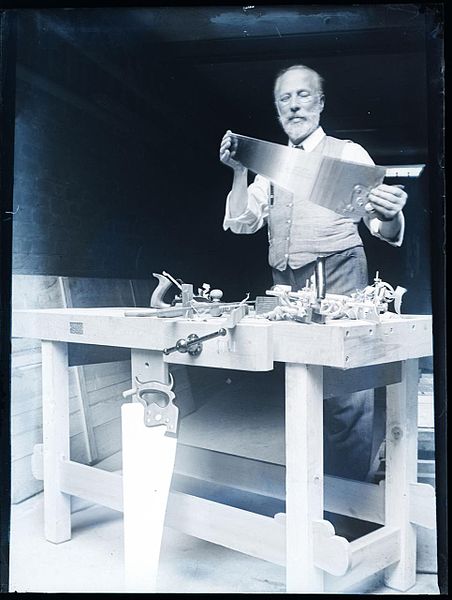
Walter Rose continued to remain convinced in the continuation of craftsmanship assured by the demands of human nature for homes that were separate (not mass produced) and built by people who were honest, tactful, courteous, and prompt. He found it ironic, as an old man, that the new industrial urban entrepreneurs of the 20th century considered it one of their greatest luxuries to retire to a country cottage “amid ancestral trees where the village folk still dig and delve”. As we have seen, not every man in the trade could rise to mastery, but the idea persisted, at the end of the era as in the beginning, that with pride, hard work and intelligence he could rise above the ‘common’.
 Mysteries of the Carpenter