
One of the greatest innovations of the ancient Romans was in the use of concrete. While the mixing of sand with lime (calcium oxide) and water to create mortar, and with an aggregate to create concrete, was known to the Greeks, it was the Roman addition of pozzolana, a volcanic ash, that improved the quality of concrete. The ash would absorb excess lime, strengthening the cement. Lime was obtained by burning limestone in kilns and then “slaking” with water. Lime, in reaction to water, forms the necessary chemical bonds required to harden the cement. Having the proper mixture of ingredients was crucial, and too much lime could weaken the structure. The concrete aggregate could be anything inert, from small stones to broken-up tile and brick. Concrete forms were usually permanent walls of stone or brick between which the concrete was placed. Unlike modern construction, in which the aggregate is mixed with the cement before being placed, the Romans would usually place the aggregate in layers, over which the cement was poured. The use of concrete can still be seen all over the ancient Roman world in buildings, aqueducts, and other structures.

A famous example is the Pantheon in Rome, completed by the emperor Hadrian in 126 CE. Behind its granite portico, the temple rotunda consists of a cylinder of stone, brick and concrete that supports a massive concrete dome, twenty feet thick at the base and 120 feet across. The design is strengthened by sophisticated arches, vaults, and coffers, and lightened using aggregates such as pumice. It is the largest un-reinforced concrete dome in the world. Although there is no wood to be seen, the Pantheon was originally created using wood as temporary ‘centerings’ for arches and forms for vaults and domes.
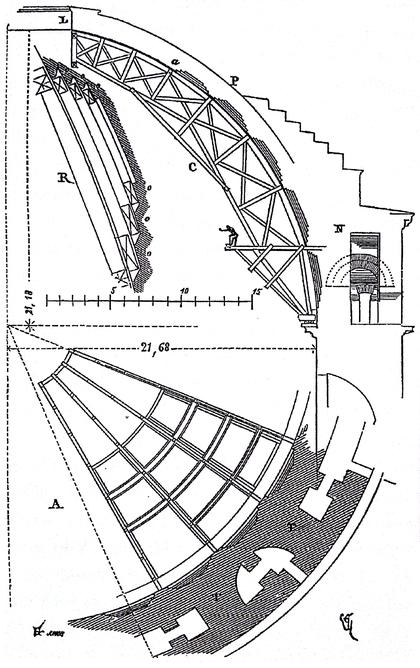
 Mysteries of the Carpenter