
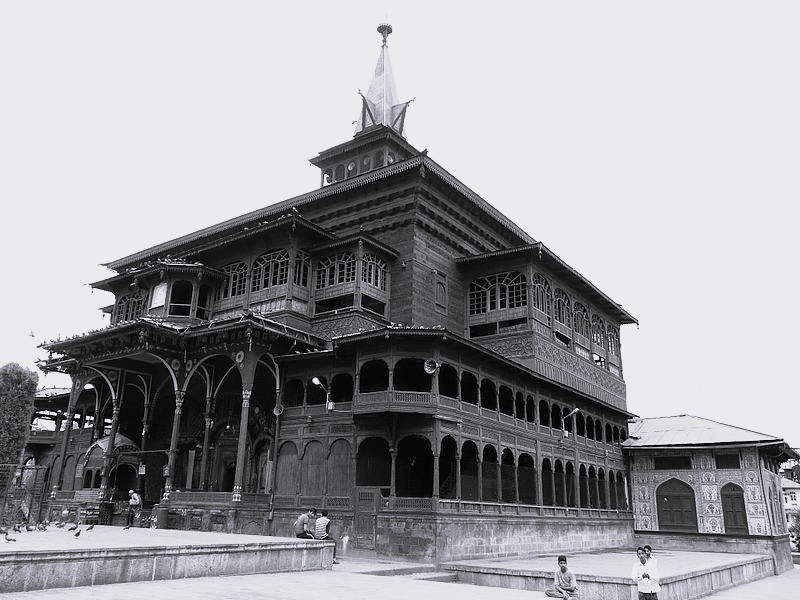
The greatest expression of the northern Indian style can be found in Srinagar, the ancient capital of Jammu and Kashmir. Here, enormous timber-framed mosques, or Shah-Hamadan, display beautifully carved pillars, jambs, doors, brackets, and screens of wood. The roofing looks ‘shaggy’, being constructed of grass, mud, and dung, is waterproof and insulating, and in the springtime, is covered by colourful wildflowers. In the Kashmiri vernacular, the traditional timber-framed building was square in plan, a requirement for efficient heating from a central hearth. Strong foundation walls were made of stone rubble set in lime mortar. This mortar was made by burning and crushing limestone (in the south, a similar product was made from seashells). Many houses were three or four storeys high, timber-framed with brick infill. In response to the cold weather, open courtyards were not common. Instead, the traditional façade featured at least one zoondab, an ‘arabesque’ bay window or enclosed balcony that jutted out from the building and overlooked the street. The zoondab is supported by either cantilevered floor joists, or by diagonal brackets. The zoondab provides ventilation, light, and compensates for the lack of an outdoor courtyard or garden. Most woodwork was of cedar, pine, or fir, but wealthier homeowners would also pay to import hardwoods such as teak and walnut for finely carved details. The traditional Kashmiri roof was sheathed with birchbark and covered with a layer of mud and grass.
 Mysteries of the Carpenter