
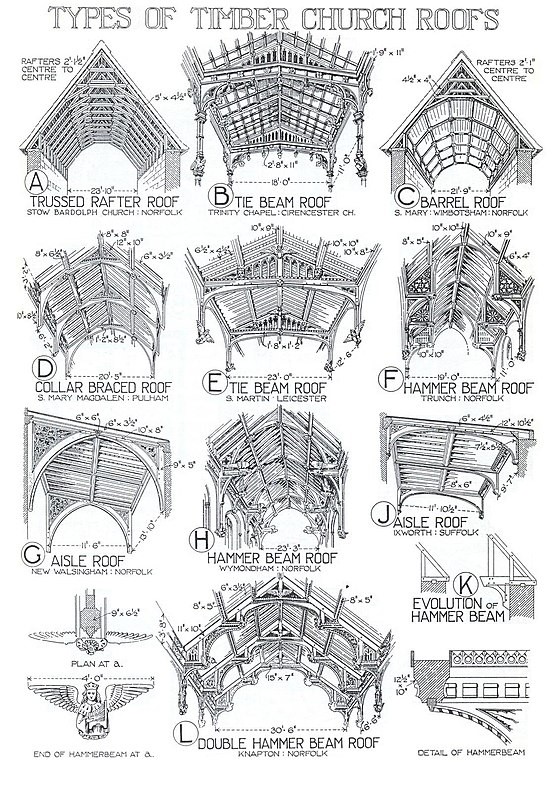
Under the command of King Richard II, a new roof was constructed for the Great Hall of Westminster in London. This became famous for its ‘hammer-beam’ truss that spans a space of 68 feet, forgoing the need for interior support and allowing for the majestic curving profiles of the giant trusses, of which there are thirteen. The structure seems lightweight, rising effortlessly toward the heavens while, in fact, the principal rafters are made of massive twelve inch by seventeen inch oak timbers. The series of cantilevered beams and curved braces is thought to have evolved from the triangle found at the top of the wide masonry walls that, when the horizontal plate was lengthened, was supported by a curved brace from below, coming out from the interior of the wall. Subsequently another brace rested on the end of the first beam and supported the second. Westminster Hall was built under the supervision of Hugh Herland, the ‘King’s Carpenter’. He and his father William had previously devised hammer-beam trusses for St George’s Hall, at Windsor Castle. Other hammer-beams were constructed for important relatives of the King such as John of Gaunt. But none were of the scale of the Great Hall. The gathering and seasoning of the necessary timbers began three years before the construction, which was first prepared and pre-assembled at a ‘framing yard’ in Farnham, Surrey, Thirty-nine miles from the site. Three hundred wagons, thousands of oxen, and hundreds of men were used to transport the timbers to barges on the Thames River. The dressed timber finally made its way to London, an effort that took an entire month.
William Brian Logan recently observed that “the greatest work of art of the European Middle Ages is not a painting, not a sculpture, not a cathedral. It is … the timber-framed roof of Westminster Hall”. Sir Banister Fletcher called it “the most magnificent” of timber roofs, and for Cecil Hewitt it is “the supreme work” of European carpentry. John Harvey joins the chorus with this hymn: “[It is] the greatest single work of art of the whole European Middle Ages. No such comparable achievement in the fields of mechanics and aesthetics remains elsewhere …”
 Mysteries of the Carpenter